In this guide
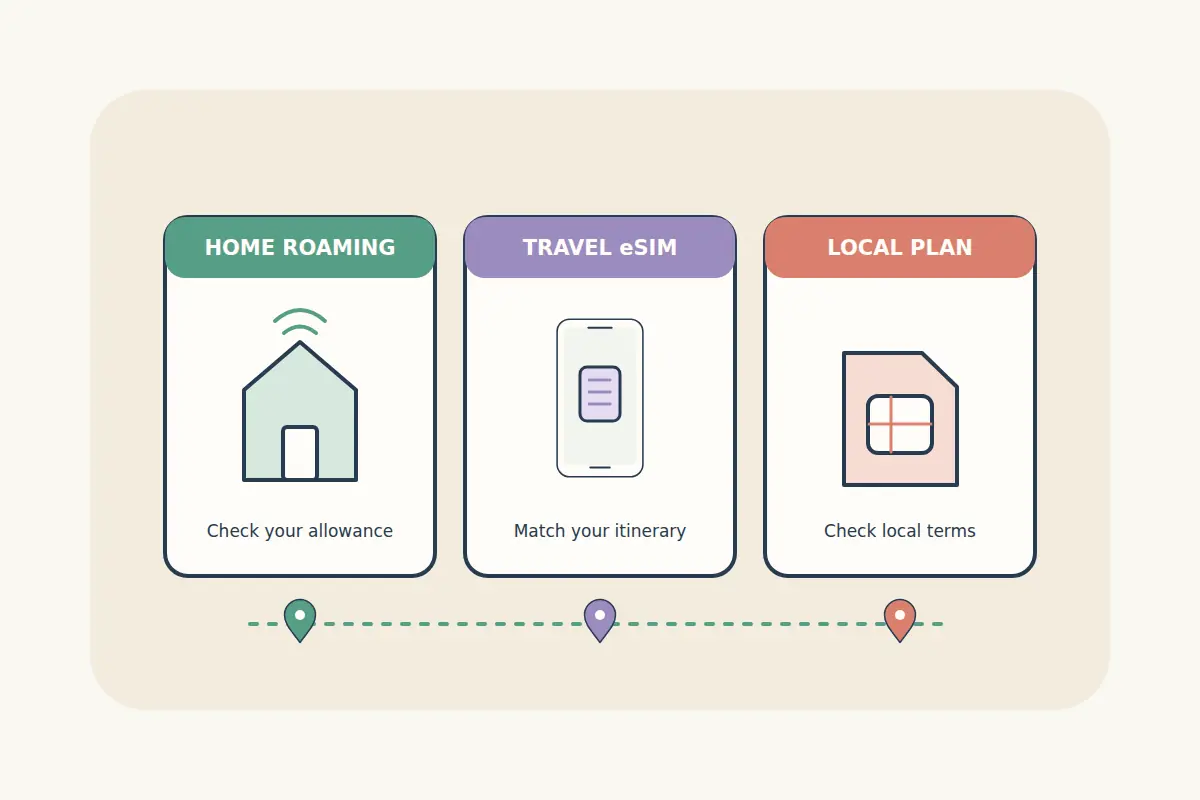
There is no single mobile plan that is best for every trip. Your home provider may already include the country you are visiting; a separate travel eSIM may fit a short holiday; a local provider may offer the number or services you need for a longer stay. Compare the actual plans before choosing.
The labels also describe different things. An eSIM is a way to install a mobile subscription, while roaming describes using a subscription away from its home network. Your home line or a local provider's plan can also be an eSIM. Here, travel eSIM means a separate plan selected for the trip, not a promise about price or coverage.
Compare three ways to stay connected
| Option | How it fits a trip | What to check first |
|---|---|---|
| Home-plan roaming | Use your existing subscription abroad, with any included allowance or travel pass. | Included countries, charges, fair-use conditions and calls or texts. |
| Separate travel eSIM | Install a plan covering the destination or route you select. | Device compatibility, package coverage, validity and included services. |
| Local provider's SIM or eSIM | Choose a subscription from a provider in the destination. | Eligibility, setup, any identity checks, renewal terms and number arrangements. |
Compare like with like. A data-only package and a plan with calls and SMS do not provide the same service. A daily roaming pass and a package lasting several weeks also need different cost calculations.
Check your home plan before buying anything
Apple's international travel guidance recommends checking whether the destination is already included in your provider's roaming arrangements or whether a travel pass is available. That can change the decision before you shop for another plan.
Read the provider's current terms for your exact subscription. Check how a chargeable day begins, whether a fair-use limit applies and what happens after the included allowance is used. Ask about calls, outgoing messages and receiving calls separately from mobile data.
Also consider transit stops. An airport connection can put your phone on a network in a country outside your main holiday destination. Do not assume a regional roaming bundle covers every place where you change planes.
Compare the total cost for the same trip
For a daily pass, work out how many chargeable days your itinerary could trigger. For a prepaid package, check whether its validity spans the whole trip and whether you might need a top-up. Include any home-line charges you could still incur while the separate travel plan is active.
Write down these three totals rather than comparing headline numbers:
- Home roaming: pass or usage charges for the whole itinerary, plus excluded services.
- Travel eSIM: the chosen package, any necessary top-ups and any separately used home-line services.
- Local plan: purchase and setup costs, the required subscription period and any renewal or cancellation obligations.
No guide can determine the cheapest option without the current offers and your usage. A short trip with roaming already included can produce a different answer from a longer route through several uncovered countries.
Decide whether you need data, a number or both
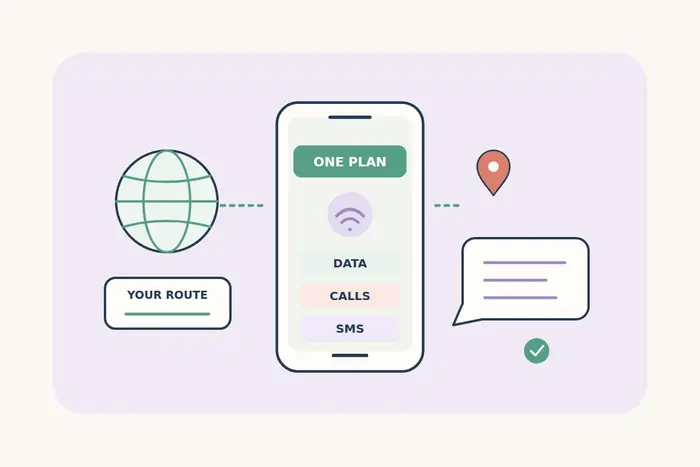
Maps, email and internet messaging can make a data plan sufficient for some travelers. Calling an ordinary telephone number or sending an SMS is a different requirement. If you need a local contact number, incoming calls or particular message services, confirm them explicitly with the selected provider.
Read our guide to travel eSIMs with calls and SMS before assuming a data allowance includes those services. Keeping your existing messaging account is another consideration; see how to keep your WhatsApp number.
On supported dual-SIM devices, a home line and travel line can have different jobs. Check the active data, voice and message settings so a call or automatic data switch does not use a line you meant to leave idle.
Check devices, coverage and setup
Use the eSIM compatibility guide for your exact model and market version. Confirm any carrier-lock restriction before purchasing a separate provider's plan. A physical local SIM needs a compatible slot; a local eSIM still needs eSIM support.
For coverage, check the actual country list and available network information, not just a region's name. The regional versus global eSIM guide helps with a multi-country itinerary. Installation and activation policies also matter: read when the selected package's validity starts and arrange a reliable connection for setup.
A local subscription can have provider-specific purchase and registration steps. Check those with the provider before relying on buying it immediately after landing, particularly if you will arrive outside normal shop hours.
Match the plan to your usage
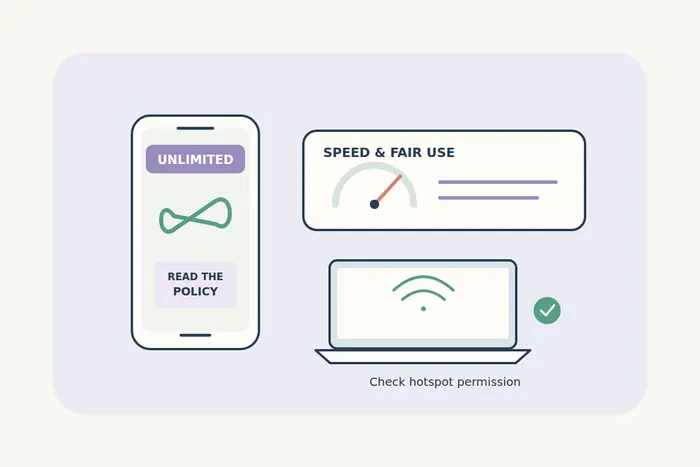
Estimate your data needs using the apps you will actually use and your phone's recent usage records. Our travel data allowance guide is a useful starting point. If you need to connect a laptop, confirm hotspot permission rather than assuming it follows from having mobile data.
Compare speed and fair-use conditions as well as the word unlimited. The unlimited eSIM guide explains why validity, high-speed usage and tethering need separate checks.
Once those questions are answered, compare CryptoTraveler eSIM destinations with the other options available to you. Choose from the payment methods actually offered for your order, and keep the installation instructions accessible before departure.
Roaming and travel eSIM questions
Is a travel eSIM always cheaper than roaming?
No. Check whether roaming is already included, the full trip length, services and package conditions. The lowest headline price does not establish the lowest total for your needs.
Can a local SIM also be an eSIM?
Yes, where the local provider offers an eSIM subscription and your device supports it. Local describes the provider or plan; eSIM describes the installation format.
Should I turn off data roaming for every travel eSIM?
Follow the selected package's instructions. Review the home and travel lines separately rather than applying one setting without checking how the travel service connects.
Can I keep my existing number?
A separate travel plan does not by itself transfer your home number. Check dual-SIM support, the home provider's charges and which line handles calls and messages.