In this guide
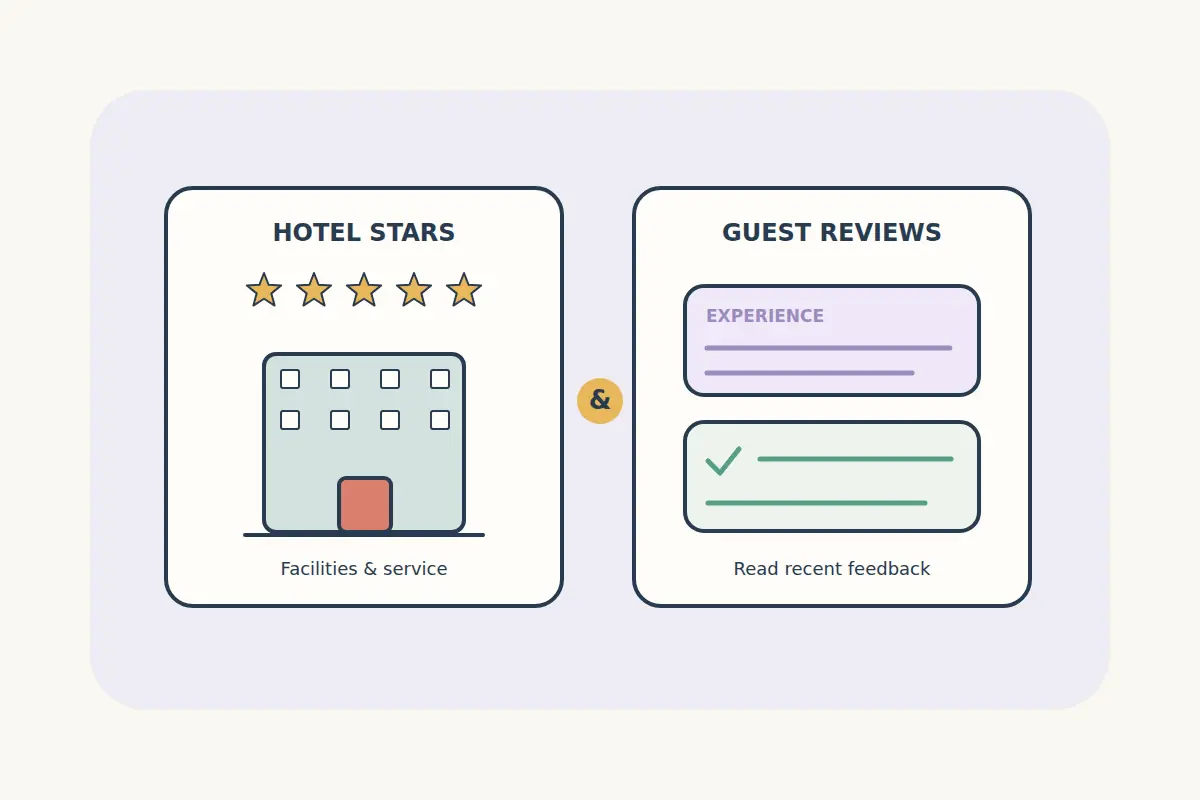
A hotel can have more stars and a lower guest-review score than another property. That is not automatically a contradiction. A star classification describes a set of standards or facilities within its scheme; a guest score reflects feedback from the people represented in that review system.
Use the two signals together, then check the things that decide whether a stay will work for you: location, the actual room, included meals, cancellation terms and the total cost for your dates. The most useful shortlist is built around your trip, rather than one number.
What hotel stars can tell you
A formal classification can help you understand the facilities and service standards assessed under that scheme. The Hotelstars Union explains its criteria for rooms, bathrooms and hotel services, while its scheme overview describes the classification process.
Check which classification or rating source applies to the hotel you are considering. Do not treat a star label as a complete room specification or assume every country and listing uses an identical scheme. The property's actual details remain important.
For example, if you need a lift, a particular bed arrangement or accessible bathroom features, look for that specific information. A broad star category is not enough to confirm a requirement that determines whether you can use the room.
What guest-review scores add
Guest feedback helps you ask different questions: are travelers describing a comfortable room, helpful service, intrusive noise or unreliable Wi-Fi? Read the comments behind a score where they are available, and look for recent accounts that relate to the kind of stay you are planning.
Notice the scale and number of reviews. A score out of five is not directly the same display as a score out of ten. A small sample also gives you fewer experiences to examine than a larger one. Neither point supplies a universal formula for predicting your own stay.
| Signal | Useful question | What to check alongside it |
|---|---|---|
| Star category | What facilities or standards were classified? | The applicable scheme and actual hotel features. |
| Guest score | How did the represented guests rate their stays? | Scale, review count, dates and comments. |
| Location | Will this address suit my plans? | Map position, transport and realistic routes. |
| Room and rate | What am I booking for these dates? | Occupancy, beds, meals, cancellation and charges. |
Read recent feedback for repeated, relevant themes
Choose two or three things that matter most to your trip, such as sleep, transport access or a room suitable for children. Then look for repeated observations about those things. A detailed comment about street noise can be more useful to a light sleeper than a general statement that the lobby looks impressive.
Read both positive and negative feedback. One enthusiastic review or one serious complaint deserves context: what happened, when, in which room type and how did the property respond? Do not assume an old room description still applies, but do not assume refurbishment has solved a problem without current information either.
Illustrative comparison: imagine one property has four stars and a guest score of 8.2/10, while another has three stars and 8.8/10. Those invented figures do not prove which is better. Check whether the first offers a facility you need and whether the second's comments describe the experience you want.
Put the address on a map
Compare the hotel with the places you will actually visit. A centrally described property may still be inconvenient for your meeting, departure airport or preferred beach. Map distance is a useful starting point; road routes, crossings, traffic and public-transport access can change the practical journey.
Use hotel destinations to browse cities and countries, then open a hotel's details and map to examine the surrounding area. Nearby alternatives are useful for comparison, but proximity alone does not establish that their rooms or rates are interchangeable.
Compare the exact room and rate
Once you have a shortlist, search your real dates, room count, adults and children's ages through CryptoTraveler hotel search. A directory entry describes a property; a dated offer supplies the rooms and conditions available for that search.
- Check the room description and permitted occupancy, not just the room photograph.
- Confirm bed arrangements and distinguish guaranteed inclusions from requests.
- Compare the meal plan; read our hotel board-basis guide if the labels are unfamiliar.
- Check the cancellation deadline and penalties for the selected rate.
- Review deposits, local charges and other costs that may be payable at the property.
Two offers for the same hotel can have different room types or conditions. A strong review score does not turn a non-refundable room into a flexible one. Our cancellation-rate comparison helps you weigh that choice.
Build a shortlist around three priorities
Write down one essential location requirement, one essential room or facility requirement, and the flexibility you need. Remove properties that clearly fail those requirements before using stars, reviews and price to compare the remaining options.
For a family, that might mean suitable occupancy, a practical room arrangement and a manageable arrival journey. A work trip may put a specific address, sleep and a desk ahead of leisure facilities. These are examples of priorities, not promises that a particular star category will provide them.
Before payment, review the selected room and conditions one more time. Paying with Bitcoin or another supported crypto changes how you settle the booking; it does not replace the room-rate terms.
Hotel rating and review questions
Is a five-star hotel always better for my trip?
It may offer facilities or service standards you value, but suitability also depends on location, the room, conditions and your priorities. Confirm the details you need instead of relying on the category alone.
Should I choose the hotel with the highest guest score?
Use the score to investigate, then read recent relevant feedback and compare the scale and sample. It cannot tell you whether a particular room or address suits your plans.
Can I compare scores from different websites directly?
Check the scale, review source and population first. Similar-looking numbers can summarize different groups of guests and different time periods.
Does the hotel's star rating guarantee a refundable booking?
No. Refundability belongs to the selected rate's conditions. Start with the hotel directory, then review availability and rate terms for your dates.