In this guide
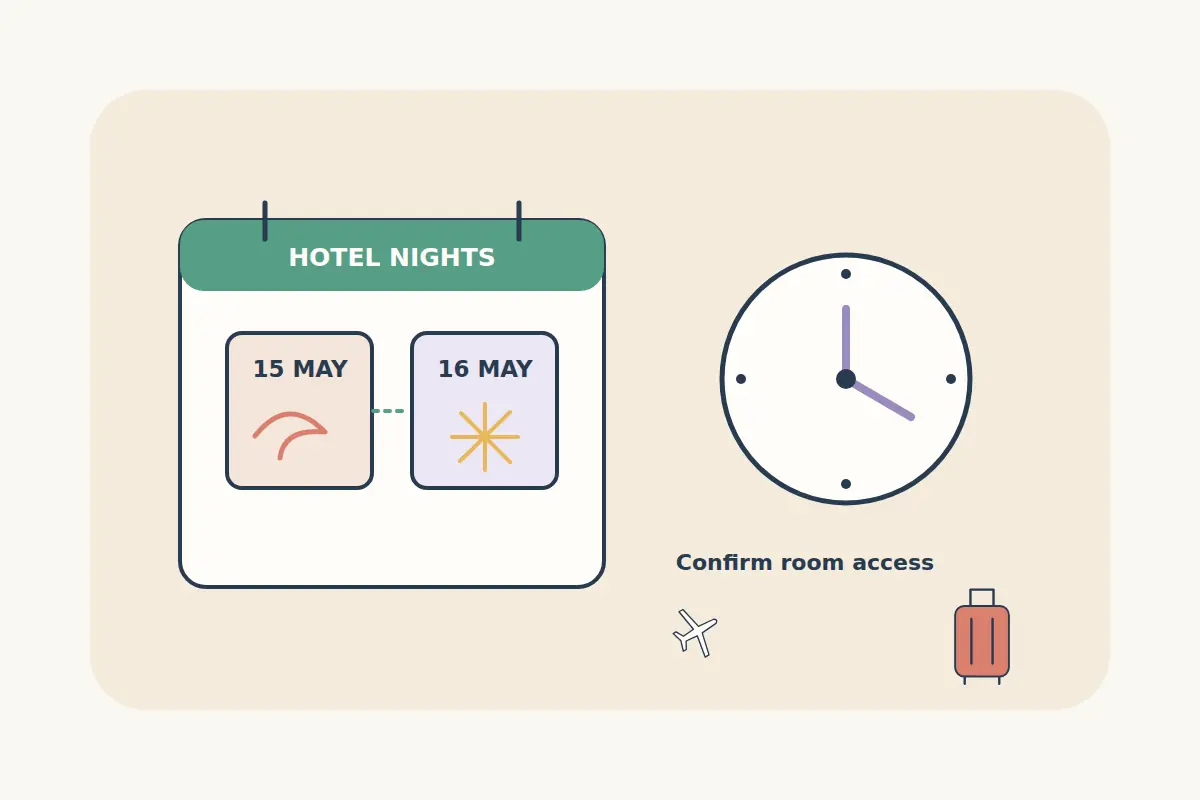
Your hotel dates and your flight dates need to describe the same journey. A booking starting on the day you land does not automatically give you a room at the moment you arrive, and a late flight home does not automatically extend checkout.
Before paying, compare the hotel's stated check-in and check-out times with the local time you expect to reach reception. Allow for the journey from the airport, and resolve any essential room-access requirement with the property.
Understand which nights the booking covers
A hotel reservation has an arrival date and a departure date, with the property's room-access times attached to them. Read the selected rate and property information rather than assuming every hotel uses the same schedule.
Illustrative example: suppose a booking runs from 15 May to 18 May and the property lists check-in from 15:00 and checkout by 11:00. Those are three booked nights. The example times are not a standard or a promise for any hotel; use the actual property's stated policy.
| Your plan | Question to resolve |
|---|---|
| Reach the hotel before check-in | Is early room access confirmed, or will you wait? |
| Arrive after midnight | Which hotel night must be reserved, and is late arrival arranged? |
| Leave for the airport late in the day | What happens between checkout and departure? |
| Flight delay changes the arrival time | Who must be notified, and what are the late-arrival or no-show conditions? |
Early check-in is a request until confirmed
If you land in the morning, check when you will reach the hotel and whether you need immediate access to a room. A request for early check-in is different from confirmed access at a specified time.
Hilton's guidance, for example, says availability varies by property and early or late arrangements are not guaranteed; fees may apply. Other hotels have their own policies. Confirm the terms for the property and rate you are booking.
If immediate access is essential, ask what can actually be reserved. Booking an additional night can be one option, but the hotel must understand when you will arrive and how the room should be held. Do not independently assume that booking the preceding night solves every late-arrival or no-show condition.
Handle arrivals after midnight carefully
The calendar can make a night-time arrival confusing. If your flight lands at 00:30 on 16 May, arriving at reception later that morning is not the same as arriving in the afternoon of 16 May.
Using the fictional 15:00 check-in example, a reservation beginning on 16 May would normally point to room access later that day under those stated terms. If you need a room in the early hours, discuss the night beginning 15 May and confirm the late arrival, reception arrangements and room hold with the property before booking.
Tell the hotel the full local date and expected arrival time, not just that you will arrive late. Include the booking reference and confirm how to contact reception if your flight is delayed. A note entered as a request is not itself proof that the property has accepted an arrangement.
Plan the gap before a late flight home
Check the departure day's room-access deadline against your airport transfer. If your flight leaves at night, decide what you need after standard checkout: a place to leave bags, a room for longer or simply a plan for the afternoon.
Ask the hotel which options are available, what they cost and when they can be confirmed. Luggage storage, changing facilities, day-use rooms and late checkout should all be treated as questions, not assumed inclusions. Access to a room is separate from access to the rest of the property.
If you need a guaranteed arrangement, obtain clear confirmation of the times and any additional charge. Keep it with the booking details so reception and the traveler have the same understanding.
Check the rate conditions and guest details
Changing the booked dates is different from requesting a timing adjustment within the existing stay. Review cancellation and amendment terms before changing plans, especially for a restrictive rate. Our refundable versus non-refundable comparison explains that part of the choice.
Check the lead guest's name, room occupancy, children's ages and any documents requested for arrival. Read the family room allocation guide if several rooms or children are involved.
Paying online with Bitcoin or another supported method does not replace the property's check-in process. A deposit, local charge or accepted-card requirement may still apply; see our hotel deposit and check-in charges guide.
A booking checklist for unusual arrival times
- Use the local arrival date and expected time at the property, including the airport journey.
- Read the actual check-in and checkout policy for the selected hotel.
- Decide whether early or late room access is essential or merely preferred.
- Confirm arrangements, charges and reception access directly where necessary.
- Choose the correct booked nights and review the rate conditions.
- Retain confirmation and notify the property if the arrival plan changes.
Browse hotel details to compare properties, then use hotel search for your actual dates and guests. Review the final confirmed booking against the flight confirmation so a date mismatch is easier to spot before travel.
Hotel arrival and departure questions
Does a morning flight arrival include early hotel check-in?
No automatic arrangement follows from your flight time. Check the hotel's stated policy and confirm early room access if you need it.
Which date should I book when I arrive after midnight?
Work backward from when you need room access, using the property's actual times. Explain the full local arrival date and time to the hotel and confirm which night and late-arrival arrangement are required.
Is late checkout always free?
Check the selected property's terms and availability. Get any agreed time and charge confirmed rather than assuming a request has been accepted.
Can the hotel cancel the room if my flight is delayed?
Read the late-arrival and no-show conditions, and notify the property through the appropriate contact route. Do not rely on a general guide to override those conditions.