In this guide
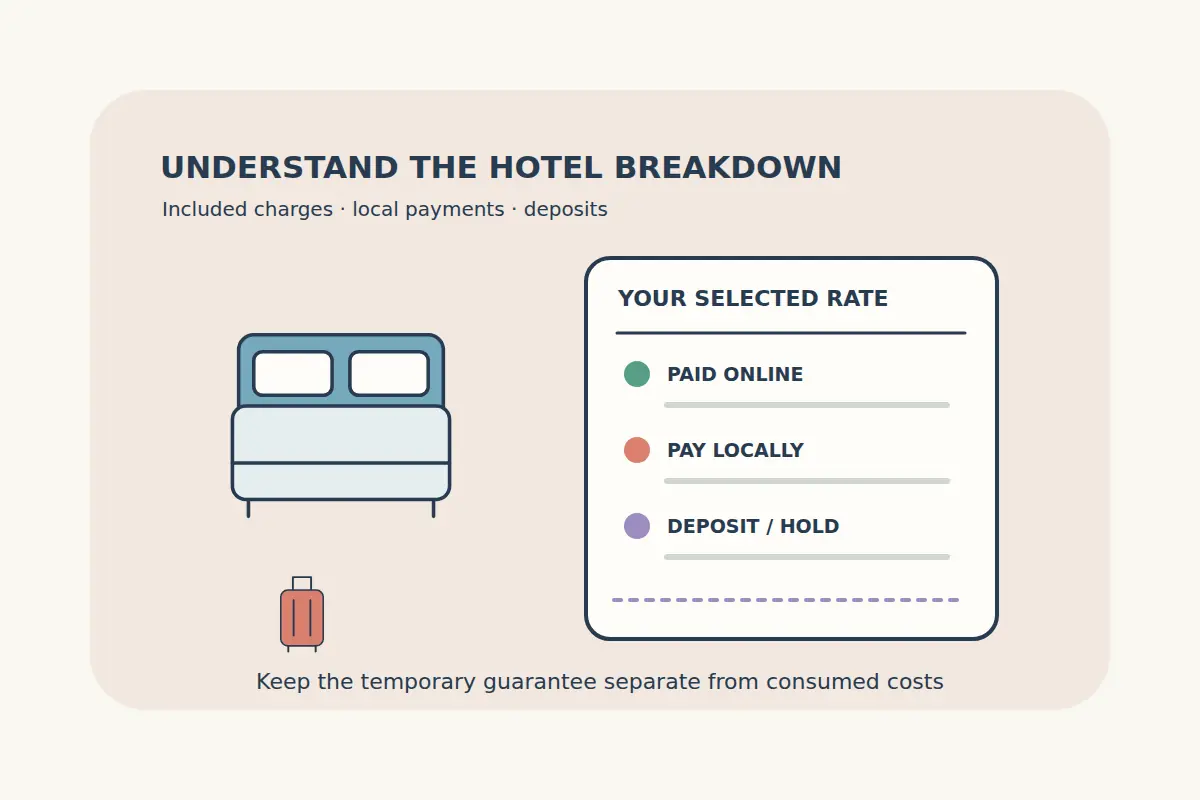
A hotel price breakdown can contain several kinds of amount: accommodation paid online, a charge collected at the property, an optional service and a deposit or hold. Understanding which is which helps you compare rates and arrive with the payment method and available funds the property requires.
Start with the exact room, dates and guests. A tax or fee mentioned in one property's conditions is not an amount to add automatically to every other hotel booking.
Separate what you pay from what you need available
| Amount | How to read it | What to establish |
|---|---|---|
| Online booking total | The accommodation and inclusions purchased in that order. | Which room, nights, guests, taxes and fees it covers. |
| Locally payable charge | An amount identified as collected at the property. | Whether it is already included, its calculation and payment currency. |
| Optional service | A service you choose under its stated conditions. | Whether it is selected, included or paid separately. |
| Deposit or card hold | A guarantee under the property's conditions. | Accepted method, amount and return or release process. |
A deposit can affect the funds you need available without becoming an additional consumed cost if it is fully returned or released. Keep it separate from taxes and services you actually pay for.
Read the basis of a tax or local charge
A locally payable amount can be described per person, per room, per night, per stay or as a percentage. Read the actual basis before doing the arithmetic. Guest ages, exemptions or other circumstances may matter under the applicable rules and selected conditions.
Do not calculate a percentage against an assumed base or apply an adult amount to every child. If the supplied information does not establish the payable amount, ask the property or booking support to clarify it for your dates and guest group.
Check whether the rate already includes the stated charge. An itemised fee can be part of the total rather than an additional payment. Counting the same amount twice produces a misleading comparison.
Distinguish mandatory fees from optional services
A mandatory resort or destination fee is a different question from an optional service such as parking or a separately purchased breakfast. Read the selected rate and property conditions rather than inferring inclusion from a general facilities list.
A hotel can have a pool, parking area or restaurant without every related service being included in every room rate. Conversely, a rate can expressly include a benefit that another rate at the same property sells separately. Our meal-plan guide explains that distinction for food arrangements.
For official US-context information on mandatory-fee disclosure, see the Federal Trade Commission's fee guidance. Use current applicable rules and the actual booking breakdown; a disclosure example is not a worldwide tax schedule or a fee for your selected hotel.
Work through an example without treating it as a quote
Illustrative example: two adults book three nights for €360 prepaid, including the rate's stated mandatory service fee. The fictional conditions separately specify a €4 local tax per adult per night. That local tax is €24, so the accommodation and local-tax cost is €384.
If the guests also choose optional parking at an invented €15 per night, another €45 makes the total €429. A separate €100 incidental hold would affect the funds required at arrival but should not be added as a permanent cost if it is fully released.
All amounts and conditions in this example are invented. The method is the point: identify what is included, calculate only the additional charges that apply, and keep the guarantee separate.
Check the currency and accepted payment method
Read which currency is used for the online order and for any amount collected at the property. Do not assume a locally payable figure is a fixed equivalent of the currency you used to compare rooms.
If you prepay accommodation with crypto through the offered checkout method, that settles the selected order under its conditions. It does not determine which methods the property accepts for local taxes, optional services or an incidental deposit.
Our hotel deposit guide explains card holds and arrival requirements in more detail. Resolve an essential payment-method issue before choosing a restrictive rate, particularly if a card in the lead guest's name is required.
Keep the rate and final account easy to compare
Search hotels for your dates and complete guest group, open the selected room and rate information, and read the final breakdown before payment. Compare equivalent room occupancy, meals and cancellation conditions as well as the total.
Keep the confirmation and any clarification about local charges. Before leaving the property, review an itemised account that distinguishes prepaid accommodation, local charges and services used. Raise an unexpected amount while the relevant details are easy to investigate.
If a charge remains unclear, contact CryptoTraveler support with the booking reference and the relevant breakdown. Send documents through the appropriate private support route. Our hotel booking guide covers the wider selection and confirmation process.
Hotel fee questions
Is every tax payable separately at reception?
No. Read the actual rate to establish which amounts are included and which are explicitly identified as payable locally.
Should I add a resort fee again when it is itemised inside the total?
No. Establish whether the item is included before treating it as an additional charge.
Is a deposit the same as a local tax?
No. A deposit or hold is a guarantee under its own conditions; a local tax is a charge where applicable.
Does online crypto payment cover every amount at the hotel?
Only the items included in that selected order are settled through it. Check separate property charges and their accepted payment methods.