In this guide
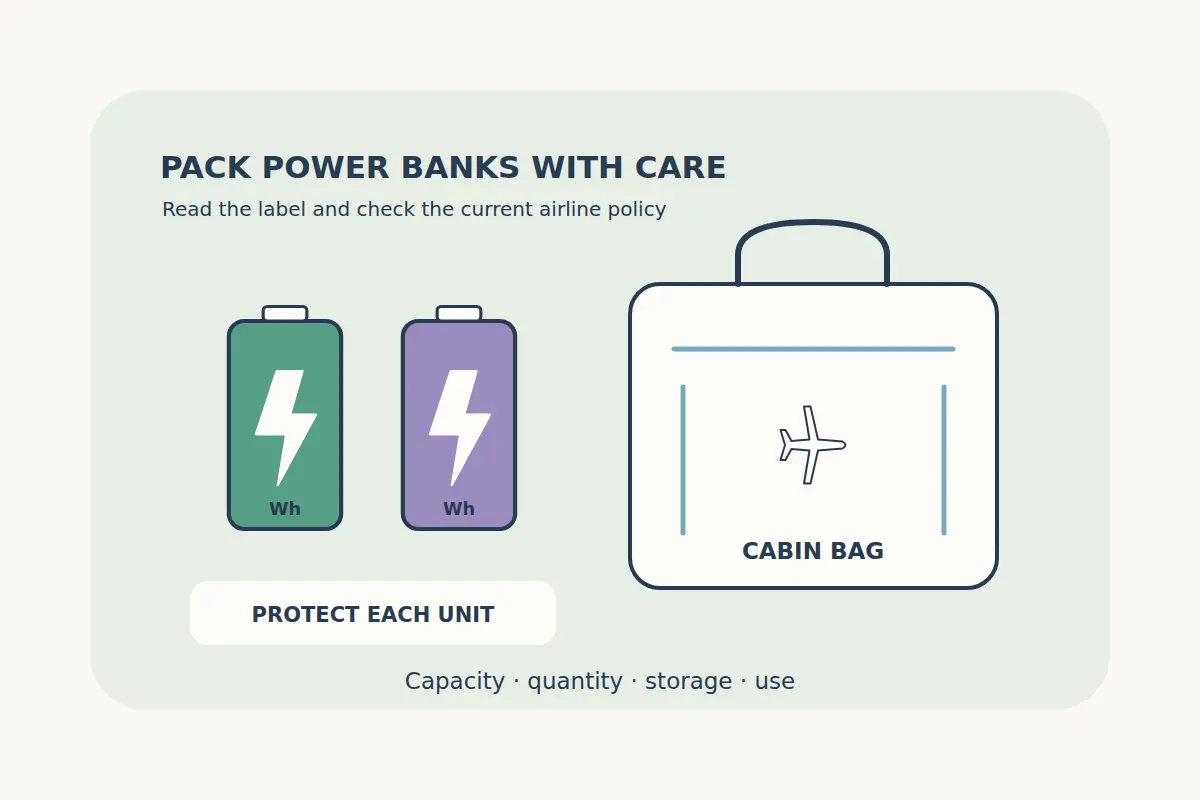
Power banks are not ordinary clothing or a passive charging cable. They contain batteries and have specific carriage rules. Pack them deliberately, check the printed energy rating and review the operating airline's current policy before each journey.
Keep permitted power banks and spare lithium batteries in cabin baggage, protected against short circuits. Remove them if your cabin bag is taken for loading into the hold. Acceptance also depends on capacity, quantity, condition and the rules applying to your flight.
Know what changed for power banks in 2026
In March 2026, ICAO announced a limit of two power banks per passenger and a prohibition on recharging them during flights. Implementation and additional restrictions must still be checked with the relevant airline and authorities.
Do not copy an older general spare-battery allowance and assume it permits the same number of power banks. Also distinguish carrying a power bank from using it to charge another device. Airlines can prohibit use and impose specific storage arrangements.
IATA's 2026 operator guidance discusses the change and the transition to its 2027 rules. For a future-dated trip, check the policy that will apply on the travel date, including every operating carrier.
Read watt-hours rather than the charging-speed label
The relevant energy rating is normally expressed in watt-hours, or Wh. A USB output label such as 65W describes power delivery, not the battery's stored energy. A large output figure does not by itself tell you the carriage category.
Where the manufacturer supplies the correct battery voltage and capacity, the calculation is Wh = volts × amp-hours, or volts × milliamp-hours ÷ 1,000. Use the battery's specified voltage, not an arbitrary USB output voltage.
Illustrative calculation: 10,000mAh at a stated nominal battery voltage of 3.7V equals 37Wh. That calculation is an example, not approval for a particular product. Keep a legible manufacturer label and any evidence the airline requires; do not alter a label to try to qualify.
Compare the actual capacity and airline conditions
| Item or rating | What to check | Packing decision |
|---|---|---|
| Power bank up to 100Wh | Airline quantity, marking, storage and use conditions. | Carry only a permitted unit in the cabin. |
| Power bank over 100Wh | Whether the specific carrier accepts it and requires approval. | Do not assume another airline's permission applies. |
| Spare lithium battery | Its own capacity, quantity and terminal-protection rules. | Keep permitted spares in the cabin, individually protected. |
| Battery installed in a device | The device's rules, including shut-down and packing conditions. | Do not treat it automatically as a spare battery. |
| Damaged or recalled battery | Safety and recall instructions from the manufacturer and authority. | Do not pack a hazardous unit for the journey. |
As a specific current carrier example, Singapore Airlines publishes power-bank capacity and approval conditions, a two-unit limit, accessible storage requirements and a ban on use and charging during the flight. Those instructions are not a universal permission for other airlines.
Protect terminals and prepare for a gate-checked bag
Use suitable individual protection, such as the original packaging or a protective pouch, and insulate exposed terminals as instructed. Keep loose batteries away from keys, coins and other conductive items. Avoid crushing or damaging the units while packing.
The FAA PackSafe guidance explains cabin carriage and warns about damaged or recalled batteries. It also distinguishes dangerous-goods safety rules from security screening requirements. Passing one check should not be treated as permission to ignore the other.
Before boarding, put permitted batteries where you can remove them promptly if staff take your bag for the hold. Tell staff when you need to retrieve them. Follow the airline's actual onboard storage instruction rather than assuming the overhead locker is acceptable.
Plan for a flight without power-bank use
Charge your phone before travel and save the documents you need offline. Do not base airport access on an unconfirmed seat socket or the assumption that power-bank use will be allowed. A battery percentage is particularly relevant if your boarding pass and booking details are on one device.
Prepare your check-in documents and any accepted offline boarding-pass copy in advance. If you need mobile data after landing, check destination eSIM plans and their setup instructions before departure.
Follow crew instructions if a device becomes unsafe
Tell cabin crew immediately if a battery becomes unusually hot, swells, smokes or is damaged. Do not hide the problem in a bag. If a phone slips into a seat mechanism, ask crew for help before moving the seat; IATA's traveler guidance explains this risk.
Use the departure checklist for the remaining document, luggage and connection preparations. Recheck the battery policy after any airline change.
Power bank questions
Can I put a power bank in a checked suitcase?
Permitted power banks belong in cabin baggage. Remove them from a bag that is taken for the hold.
Does 65W mean a power bank is 65Wh?
No. Charging output and stored energy are different measurements. Read the manufacturer's battery rating.
Can I always bring a 100–160Wh power bank with approval?
No. Current carrier rules and the travel date matter. Obtain explicit acceptance where available; some rules are stricter.
Can I use a permitted power bank during the flight?
Carriage does not establish permission to use it. Follow the airline's restrictions and crew instructions.