In this guide
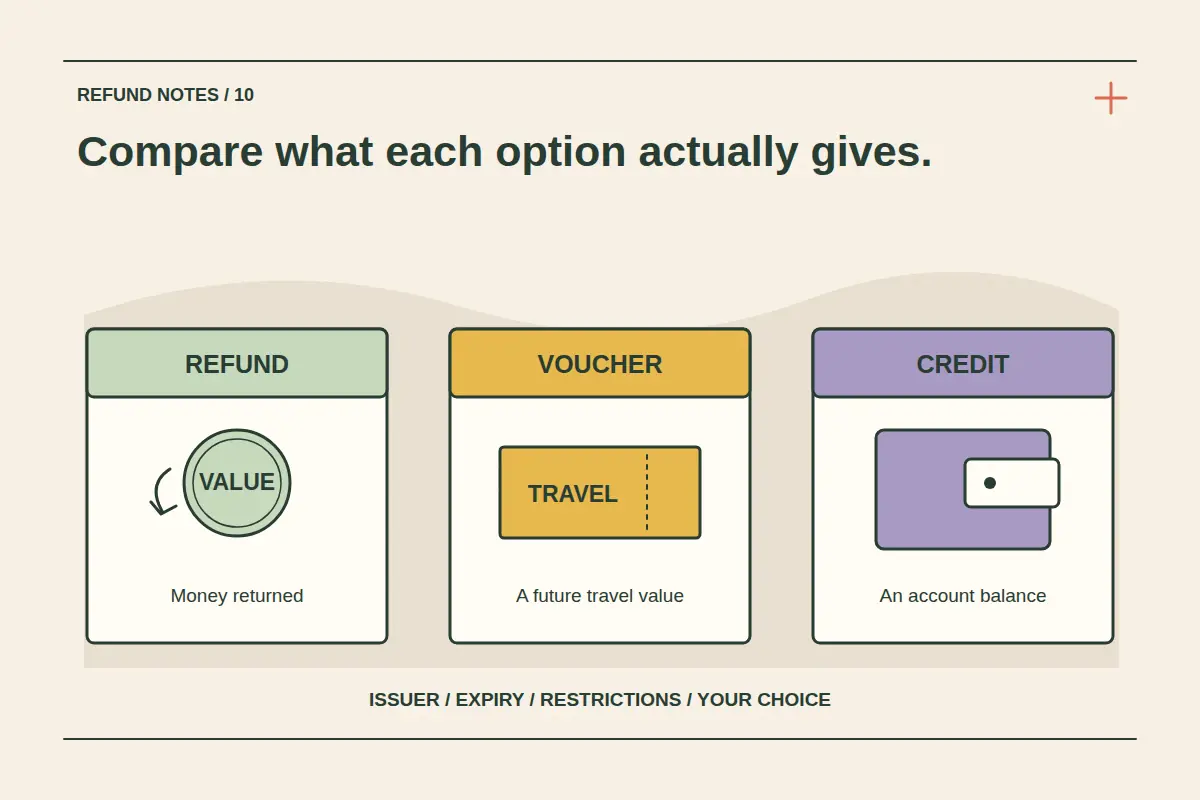
A refund, a voucher and travel credit can all have a stated value, but they are not automatically equivalent. They may differ in where they can be used, who can use them, their expiry and whether money is returned through a payment route.
Before accepting an offer, identify the issuer and the exact instrument. An airline voucher is not necessarily CryptoTraveler account credit. A provider's promised reimbursement is not necessarily money that has already reached you. Ask for the written proposal before comparing the headline amounts.
Identify what is actually being offered
| Option | First questions |
|---|---|
| Monetary refund | What amount, currency, receiving method and processing status are confirmed? |
| Airline or provider voucher | Who issued it, where must it be redeemed and which travellers or services qualify? |
| Booking-platform account credit | Which account receives it and what purchases or conditions apply? |
| Optional replacement travel | What itinerary and fare are confirmed, and how does accepting it affect other options? |
Do not infer transferability, cash withdrawal, universal product coverage or unlimited validity from the word credit. The actual instrument's terms need to answer those questions.
Establish the refund entitlement before comparing alternatives
A voluntary cancellation of an unchanged restrictive ticket is different from an airline cancellation or a qualifying disruption. An alternative may be offered in either situation, but the starting rights and conditions can differ.
The US DOT refund guidance describes refund and alternative-offer rules for covered travel. The EU passenger-rights guidance separately explains reimbursement and rerouting choices within its scope. Do not present a voluntary credit as universally compulsory when an applicable rule gives a monetary refund choice.
Check expiry and the action required before it
Ask whether an expiry is the deadline to make a new booking, to start travel or to complete travel. Those dates can produce very different practical value. Check whether unused value remains available after a partly used redemption.
For a fictional voucher valid until a specified date, being able to book on that date does not necessarily mean travel can occur indefinitely afterward. The rule may instead require travel by the deadline. Read the written condition; this example does not describe a standard policy of CryptoTraveler or an airline.
Compare restrictions, not only the headline amount
Check eligible routes, airlines, products, currencies, booking channels and traveller names. Ask about blackout periods, minimum spend, fare differences, fees and whether a remaining balance is retained. Do not assume a carrier-issued instrument can be entered as payment on every booking website.
If the value is restricted to a traveller who may not take another trip, transferability matters. If you expect to use only part of it, balance retention matters. A larger stated credit can be less useful than a smaller available refund if its conditions do not fit your actual plans.
Understand what accepting the offer changes
Ask whether acceptance replaces a different option, closes a cancellation request or settles a particular claim. Do not accept multiple conflicting offers merely to see which one succeeds. Keep the agreed scope, amount and terms together.
A ticket refund and compensation for disruption are different questions. Read the flight-disruption guide and ask what each proposed payment addresses rather than treating every voucher as compensation or every refund as a complete settlement of all issues.
For CryptoTraveler bookings, confirm the actual method
CryptoTraveler's published refund information describes possible bank, PayPal, USDC, voucher and prepaid-account-credit routes, with the method confirmed for the case. Read the current terms and the proposal; a list of examples does not promise every method is available for every booking.
For a crypto-funded purchase, separate the recorded fiat reference value from the receiving instrument and any conversion. Our coin-amount guide explains why a stated refund value is not automatically the original asset quantity.
Save a usable record and follow the issuing stage
Keep the booking reference, issuer, amount, currency, issue date, expiry, redemption conditions and support conversation. For a voucher or credit, confirm how to retrieve it and which account or traveller it belongs to. For a monetary refund, obtain the appropriate transfer reference when it is issued.
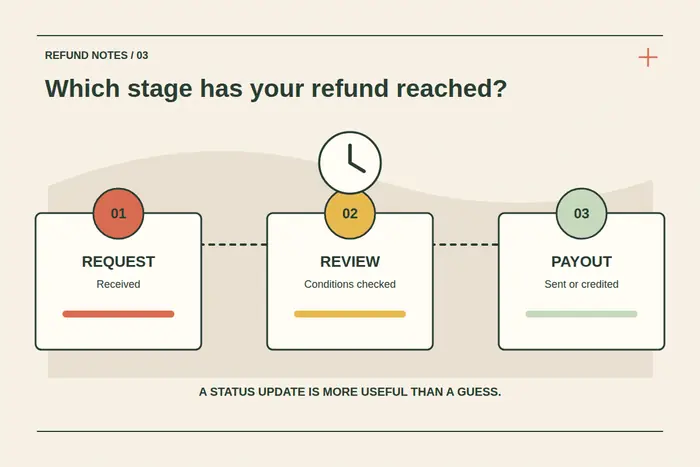
The refund timing guide helps distinguish a proposal, an approved action and a delivered payment. If something is unclear, ask support before agreeing rather than assuming the labels mean the same thing.
Refund and credit questions
Is account credit the same as cash?
Do not assume so. Check where it can be spent and whether any withdrawal or transfer option actually exists.
Can a travel voucher be used by someone else?
Only if its actual terms allow that use. Check traveller-name and transfer conditions before accepting it for that purpose.
Should I choose a larger voucher automatically?
Compare the restrictions, expiry and realistic future use. The headline amount alone does not establish which option fits your plans.